Owasa
House of LeavesWolves are a recurring figure of danger at the boundary between home and wilderness, imagination and perception, and childhood play and genuine terror. They are drawn as violent creatures, invoked through seasonal masquerade, and echoed by the watchful animal responses surrounding the Navidson family. Their significance lies less in a single appearance than in their repeated association with an expanding darkness that human beings can represent but cannot fully contain.
Wolves in the Children’s Drawings
The most concentrated appearance of wolves occurs in the drawings examined by Teppet C. Brookes, an experienced teacher who had taught children from kindergarten through sixth grade. She had seen ordinary representations of wolves, tigers, and dragons before, but these animals were radically different. The wolves did not simply move through colored woods: their teeth drew madder and rose from one another’s throats. Their violence was active, graphic, and collective, making the animals agents of attack rather than familiar figures from children’s stories.
The wolves were only part of a larger bestiary. Tigers clawed vivid colors from the hills, and a dragon incinerated everything around it with a flourishing burst of color. Yet even these scenes of destruction were subordinate to what occupied the center of each drawing: an opaque black square. The wolves therefore function as creatures gathered around an absence or enclosure, not as the ultimate source of horror. Their aggression gives visible form to the danger surrounding the house, while the black center remains more absolute than any animal body.
Chad’s drawing, produced the week before Navidson’s rescue attempt, showed a house without a chimney, windows, or door. Almost the entire page was filled by a square layered with black crayon and pencil until no paper showed through; the wolves and other marauding creatures occupied only the narrow margins. Daisy produced a strikingly similar picture in her kindergarten classroom, with the same wolves, tigers, and dragon surrounding a square made from layers of black and cobalt-blue crayon. In her version the square covered roughly two-thirds of the page, while Chad’s image had allowed virtually no margin to survive.
The progression matters. The children’s drawings do not merely place wolves inside a frightening fantasy; they show the dark center growing larger and more impenetrable. Brookes interprets the similarity between the eight-year-old Chad and five-year-old Daisy as evidence of severe distress, especially after the family’s move to Virginia and Chad’s trouble at school. The drawings transform the wolf from a conventional monster into a marginal witness of the house’s advance: the creature remains visible at the edge while the black architecture consumes the page.
Domestic Animals and the Threat Beyond the Hallway
The wolf’s meaning is sharpened by the behavior of the Navidson household’s actual animals. When Hillary appears at the end of The Navidson Record, the Siberian husky is no longer a puppy. A couple of years have passed, and something permanently watchful has entered his eyes. He remains playful with familiar people, but strangers who approach too closely hear a growl rising from deep in his throat, compared to distant thunder. Hillary is not described as a wolf, yet his guarded alertness gives the domestic animal a wolf-like relation to territory, intrusion, and unseen danger.
Mallory, the tabby cat, has a different fate. He vanishes completely, and the record offers no explanation. His disappearance remains unresolved, even though the house is said to have played only a small part in the histories of both animals. This contrast between Hillary’s survival as a watchful presence and Mallory’s unexplained absence makes the animal world resistant to the human desire for complete explanation. One animal remains as warning; the other becomes a gap in the record.
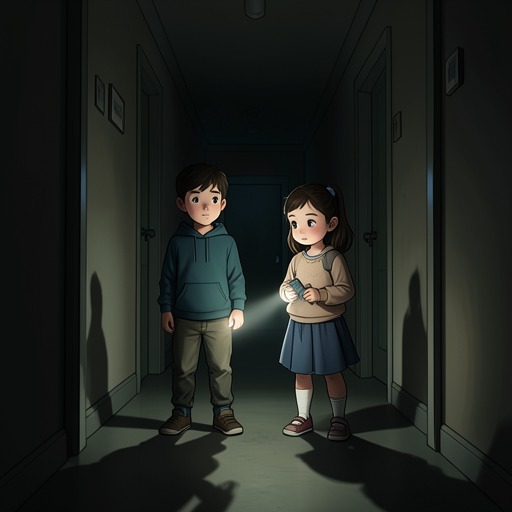
The disappearance is preceded by a precise domestic incident. On August 11, 1990, while Karen speaks by telephone with Audrie McCullogh about the house’s supposedly disastrous Feng Shui, Tom helps Navidson photograph the hallway with a strobe. A yowl and bark suddenly break out. Mallory rushes into the living room with Hillary nipping at his tail, and both animals run over the sofa, enter the hallway, and disappear into its darkness. Navidson might have followed them, but he immediately hears barking outside and Karen shouting that the animals were not supposed to be let out. The scene makes the hallway a passage through which ordinary animal play abruptly becomes disappearance, while the barking outside complicates any simple account of where the animals have gone.
Wolves, Children, and Seasonal Theater
Wolves also enter the book through Halloween, where predatory imagery is folded into communal ritual. Navidson follows his costumed children into the New England streets as they pursue candy beneath cold-colored leaves. The final images acknowledge the genre that his work resists but inevitably joins: jack-o’-lanterns, vampires, witches, politicians, and “a whole slew of eight year old ghouls” moving from house to house.
The Halloween scene does not erase danger by turning it into play. Grey ice covers the roads, candles flicker, and adults watch the children dressed as creatures while remaining alert for anything that might disturb the performance. The children are protected, but the language of wolves in sheep’s clothing gives the scene an unstable moral texture: costume makes the familiar strange, and the harmless child temporarily bears the outward form of a threat.
Navidson’s camera finally abandons the children’s painted faces and focuses on the empty road leading toward the woods. The street lamp flickers and goes out as darkness closes in. In that movement from crowded ritual to vacant landscape, the wolf remains an implied possibility rather than a visible body. The danger is strongest precisely when no creature appears, because the woods and darkness preserve the space in which the imagined predator could return.
Narrative and Thematic Function
The wolf links several scales of the book’s world. In the children’s drawings it is a product of imagination, but the drawings also seem to register a reality that adults struggle to name. In the hallway episode, actual animals encounter a space whose rules are not reliably domestic or architectural. In Halloween imagery, the wolf-like threat becomes a costume and a public spectacle, yet the final empty road restores its underlying uncertainty.
This recurrence gives the wolf a role as a border figure. It belongs to the forest, the margins of the page, and the language of predation, but it repeatedly approaches the house and the family. It is never allowed to become a fully explained monster. Instead, it appears as teeth, a growl, a vanishing animal, or a child’s surrounding image. The book uses that incompleteness to preserve the difference between representing danger and mastering it: the wolf can be drawn, performed, or heard, but the darkness around it remains larger than the sign meant to describe it.